A little more than 2 months have passed and I have found the following:
1. The front insert ahead of the dashboard squeaks when the car is cold.
the car is cold most of the time, since on long trips it is too range-consuming to heat it up. Pre-heating the car helps, however the squeaks are not only on the left and right, but sometimes in the front too. Usually that is when the temperature is near freezing. When it is 50 and higher there are no sounds. Thermal expansion in action!
2. Depending on what car you had and what you were paying for it, it may be as cost-effective to own an electric car. No doubt it is cheaper to operate, but it is also more expensive to acquire. So far my 2 month analysis shows a -46$ comparison in total cost of ownership over my previous Smart car. To be fair, the lower fuel prices did throw this comparison into the red.
3. Charging at work in the winter is a necessity, if you work ~25 miles from work. Cold range is shorter, and it would be nice to use the heater.
4. Open highway burns energy faster than a stop and go traffic.
5. I always drive with GPS, so i know the remaining distance and range. Sometimes on steep hills range range is lower than the distance remaining. Keep calm and carry on. City traffic, lower speed route, right lane, keeping the current in green will help you get to where you need to be. Just have faith and adjust your driving according to range remaining.
6. PlugShare application rocks and tells me where i can recharge in case i'm short on juice. However waiting for an L2 charger to put in some bars is far from breathtaking. Better to plan in advance.
7. I developed a habit of pre-heating the car.
8. The seat heater burns my buttocks. Repeatedly. Conversely the back is underheated. The whole seat assembly pales in comparison to Smart car's or Golf's (MK6) both in heating and comfort. So far the plan is to try heating covers, especially for the passenger.
9. USB when connected to iPhone works as a dock, and gives me turn by turn, when needed and allows me to listen to internet radio.
10. Each evening i do the math to figure out the necessary time to charge the battery (z). Then i estimate the time of departure to work (y) and the necessary delay i need to set on the keychain timer (x):
x = time between current time and required charge time (y - z).
Thus my battery is 100% charged by the time i need to use the car, and the "fully charged time" is minimized to reduce capacity loss. It matters less in the winter, but is a good habit for warmer weather. And it's a great way to stay in shape![math - wise]
Friday, November 30, 2012

Monday, November 5, 2012
First squeak
The moment i sat down in an enlarged US version of i-miev i wondered how long before it starts squeaking. I recalled my trusty Peugeots that evolved to use as little parts in the dashboard as possible and glanced to the enlargement insert around the undersized dashboard of the i-miev.
The European and Japanese versions are smaller, so to fill in the gap for a wider US version, a plastic insert was devised around the dashboard. Of course it neatly holds the tweeters, but it also producing a rattling noise on rough roads. And it's just the type of asphalt that is used in Northwest: rough.
I'll place a pic of where the noise is coming from: a horizontal connection of the higher part of the insert and lower one. So far only on the left side.

The European and Japanese versions are smaller, so to fill in the gap for a wider US version, a plastic insert was devised around the dashboard. Of course it neatly holds the tweeters, but it also producing a rattling noise on rough roads. And it's just the type of asphalt that is used in Northwest: rough.
I'll place a pic of where the noise is coming from: a horizontal connection of the higher part of the insert and lower one. So far only on the left side.
2000 miles.
11/16/2012 Update: 2300 miles, now the right side squeaks occasionally too...
11/16/2012 Update: 2300 miles, now the right side squeaks occasionally too...
Sunday, October 28, 2012
0$ spent on gas last month

Just did a budget to actuals comparison for last month and it turned out that we've spent nothing on fuel last time. Her TDI was still good with the last month's fill-up. And i-miev was so comfortable, that we used for all the grocery getting, visits to outings, cinemas etc.
It's been a month, i have yet to see the turtle.
I always have the Waze on the iPhone (it's a good GPS navigation). So i know the distances. A little bit of math, and i'm confident that i'll make it home.
Also a change in habits is looking up a charging station near destination. If it's within 10 minutes walking, i'm parking at the station. It works as a reserved parking spot + i get my walking, which is great for my heart : ).
Friday, October 19, 2012
Charging in the rain & securing the L1 charger
A couple of points. So near the factory where i work some kind individual broke into a civic to steal an antique GPS.
That individual would have been better off with my L1 charger. Judging from ebay and dealer prices, that's quite an expensive apparatus.
The rainy season has started in Seattle. For the reasons above i decided to try keeping the charger inside the trunk. I really wish there was an inside-the-trunk charging plug, but there is none. So i tried the 15A extender cord and the L1 charger. I did not lock the rear door initially. But one day it did lock itself in. Not completely, of course, but just enough to be locked and not be opened without the remote.

Disclaimer: don't do it. I do understand that i'm violating Mitsubishi's rule of not using cord extenders and also risking damaging both cables, or risking overheating. Familiarize yourself with physics and rules of conductor resistance & how it affects heating. Also inspect the cables if you chose to use this method of securing the charger. Be gentle with the door.
That individual would have been better off with my L1 charger. Judging from ebay and dealer prices, that's quite an expensive apparatus.
The rainy season has started in Seattle. For the reasons above i decided to try keeping the charger inside the trunk. I really wish there was an inside-the-trunk charging plug, but there is none. So i tried the 15A extender cord and the L1 charger. I did not lock the rear door initially. But one day it did lock itself in. Not completely, of course, but just enough to be locked and not be opened without the remote.

Disclaimer: don't do it. I do understand that i'm violating Mitsubishi's rule of not using cord extenders and also risking damaging both cables, or risking overheating. Familiarize yourself with physics and rules of conductor resistance & how it affects heating. Also inspect the cables if you chose to use this method of securing the charger. Be gentle with the door.
Wednesday, October 17, 2012
Why eco mode is limiting the peaks
Yesterday i was doing a bit of research regarding ways to prolong battery life.
There is a great NASA whitepaper about li-ion batteries that lists all the factors.
Also, after reading this, it became clear why "eco" mode limits the current draw and makes the car feel a bit unresponsive. The less current draw pikes you have - the longer the battery will serve you.
 It's an older battery technology, but you get the idea.
Assuming the first bar (Green eco) is up to 50A, second - 100A and third - 150A we're getting discharge rates of 1C, 2C and 3C for each bar respectively.
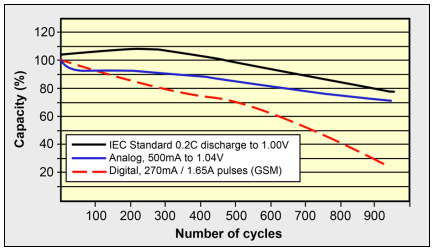
Sudden acceleration introduce current pikes and result in capacity loss with the same principle as illustrated on this graph:

Driving the car in D sure is very responsive, but it goes into pikes very easily. ECO takes some getting used to and some planning, but is extremely smooth.
My wife (a very demanding passenger) appreciates the smoothness of acceleration and breaking in this mode.
I'm glad i can plug in at work. It was 47F this morning and i had to resort to heating the car. Did not have time to pre-heat. Normal 5 bars to get to work turned into 7. an 8 hour work day will give me 6.4 bars. Rather close to full : )
Also, today the car has passed a 1200 miles odometer mark. Comparing to the Smart car i had, it is ~30 gallons of fuel that i did not burn and pay for: ).
There is a great NASA whitepaper about li-ion batteries that lists all the factors.
Also, after reading this, it became clear why "eco" mode limits the current draw and makes the car feel a bit unresponsive. The less current draw pikes you have - the longer the battery will serve you.
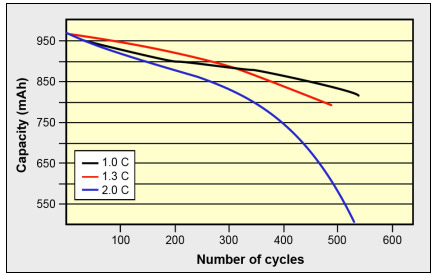
Assuming the first bar (Green eco) is up to 50A, second - 100A and third - 150A we're getting discharge rates of 1C, 2C and 3C for each bar respectively.
Sudden acceleration introduce current pikes and result in capacity loss with the same principle as illustrated on this graph:
Driving the car in D sure is very responsive, but it goes into pikes very easily. ECO takes some getting used to and some planning, but is extremely smooth.
My wife (a very demanding passenger) appreciates the smoothness of acceleration and breaking in this mode.
I'm glad i can plug in at work. It was 47F this morning and i had to resort to heating the car. Did not have time to pre-heat. Normal 5 bars to get to work turned into 7. an 8 hour work day will give me 6.4 bars. Rather close to full : )
Also, today the car has passed a 1200 miles odometer mark. Comparing to the Smart car i had, it is ~30 gallons of fuel that i did not burn and pay for: ).
Sunday, October 14, 2012
Chademo Seattle Fred Myers
Tried it today. Really cool experience. I observed the charge indicator go up, sometimes as fast as 1 bar per minute. Subsequent bars were slower.
47 to 80 % took 14 minutes. The only drawback was that the blink charger would not charge two cars at the same time. Had to wait untill a Leaf leaves, then I had to re-initiate the charging. Apparently blink charger has a bug in it, since it did not let me select the desired charge level untill Nissan left.
The power came in handy since it looks like rain and hvac on the highway reduce range quite a bit.
Missing chargers near cinemas!
47 to 80 % took 14 minutes. The only drawback was that the blink charger would not charge two cars at the same time. Had to wait untill a Leaf leaves, then I had to re-initiate the charging. Apparently blink charger has a bug in it, since it did not let me select the desired charge level untill Nissan left.
The power came in handy since it looks like rain and hvac on the highway reduce range quite a bit.
Missing chargers near cinemas!
Friday, October 12, 2012
SCIB in US 2012 i-miev?
Not really. Not yet.
We still have older-style Yuasa batteries. Here is what i found on a Japanese web-site:
Most noteable characteristic of SCiB is lifespan. The number of cycles for a SCiB, according to Toshiba is 4000 as opposed to a thousand for Yuasa LEV50.
Here is a comparison of GS Yuasa vs Toshiba:

85% capacity is retained at charge cycles at 25 degrees centigrade (~70F). SCIB data was taken from a 4.2AH cell from EV-neo Honda bike. Capacity retention is 90% after 6000 cycles with the same temperature.
For a 1000 cycles, Lev capacity is 85%, whereas SCIB is 98%.
I'll do some math to project the retained capacity over time...
Source
We still have older-style Yuasa batteries. Here is what i found on a Japanese web-site:
Most noteable characteristic of SCiB is lifespan. The number of cycles for a SCiB, according to Toshiba is 4000 as opposed to a thousand for Yuasa LEV50.
Here is a comparison of GS Yuasa vs Toshiba:
For a 1000 cycles, Lev capacity is 85%, whereas SCIB is 98%.
I'll do some math to project the retained capacity over time...
Source
Subscribe to:
Posts (Atom)